- https://bergenbibliotek.no/arrangement/is-climate-activism-dead-2014-or-just-cancelled
- Is climate activism dead — or just cancelled?
- 2026-03-05T18:00:00+01:00
- 2026-03-05T19:30:00+01:00
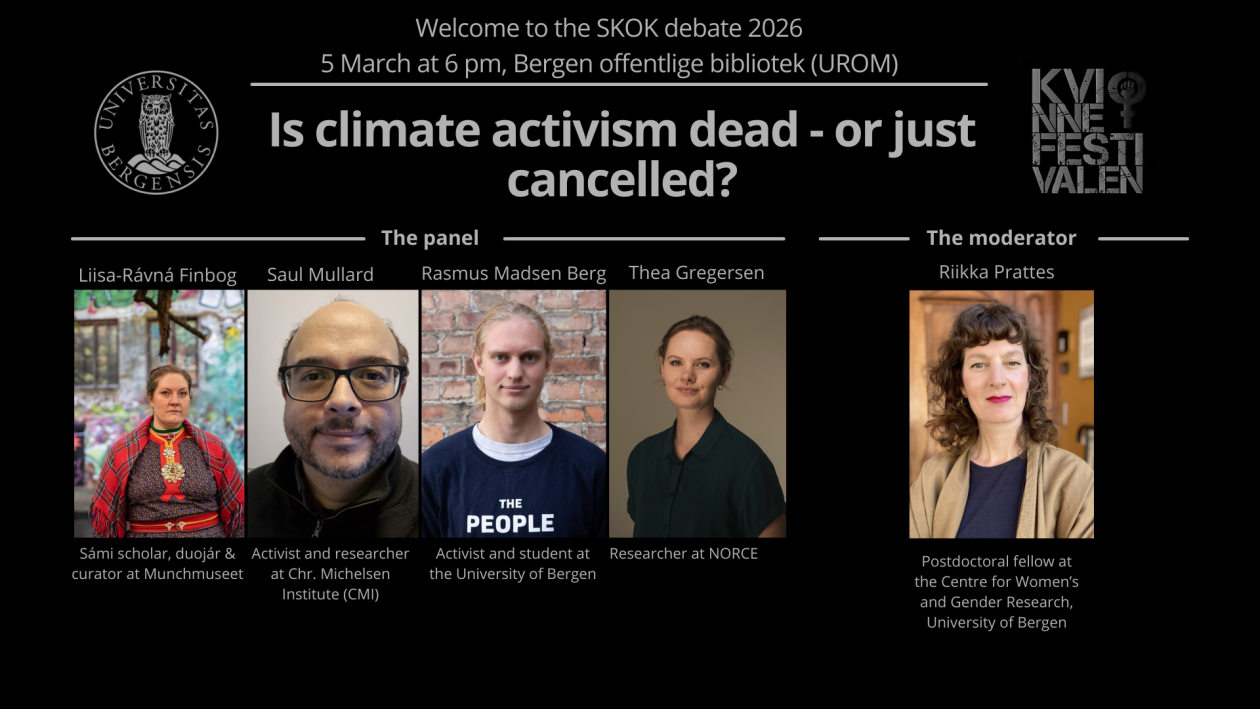
- The 2026 SKOK debate, organized by Centre for Women’s and Gender Research (SKOK) at UiB, asks: Who is climate activism for today?
While the planet is heating up, the noise around climate change seems to be cooling down. Fewer headlines. Fewer protests. Fewer young people in the streets and hardly any young men among them. Why? Has climate activism become too woke, too moral, too boring — or too female? When did taxes beat the planet in the culture wars?
From Fosen’s wind power conflict to mining in Repparfjorden. From cobalt mining in the Democratic Republic of Congo to the (ecological) destruction of Palestine. These aren’t abstract debates — they’re happening here, now.
So what’s going on? Who is climate activism for today? And how is it connected to other social justice struggles? Where did the anger go? And what does masculinity have to do with melting ice, lost nature, and political silence?
To discuss these questions and more, we are very pleased to be joined by four esteemed panelists:
- Liisa-Rávná Finbog, Sámi scholar, duojár & curator at Munchmuseet
- Saul Mullard, activist & researcher at CMI
- Rasmus Madsen Berg, activist & student at UiB
- Thea Gregersen, researcher at NORCE
The debate will be moderated by Riikka Prattes, postdoctoral researcher at the Centre for Women’s and Gender Research (SKOK), UiB.
Please note: Some participants of our event have a fragrance sensitivity (perfume intolerance), which means they may have physical reactions to scented products such as perfume, deodorant, fabric softeners, hair styling products, and other items with long-lasting fragrances. To prevent an allergic reaction, please avoid wearing perfume or other strongly scented products when attending the event. This is a simple but important way to show consideration and contribute to an inclusive environment.
The panelists
Dr. Liisa-Rávná Finbog/Rámuavuol Liisa-Rávdná is a Sámi Indigenous scholar, duojár, author, and curator. Moving between Sámi aesthetics and the materiality of creative practices, she navigates the dynamics between art and politics of indigeneity in her work. She was co-curator of the first Sámi Pavilion at the 2022 Venice Biennale and the upcoming Indigenous Quintennial at National Gallery of Canada. She is the inaugural curator of Indigenous Art at the Munch Museum in Oslo. Since 2024, she is also on the board of the Indigenous Curatorial Collective (ICCA).
A founding member of Hásstuheaddji collective, Finbog helps lead a Sámi think-tank that gathers thinkers, performers, and artists to dialogue and reflect on topics of decolonization and social justice. In 2023, she co-founded the Bárru Indigenous Academic Collective, which is an expansive and equitable gathering of Arctic Indigenous scholars, thinkers, and communities. She is also the author of It Speaks To You – Making Kin of People, Duodji, and Stories in Sámi Museums (2023, Dio Press) and co-editor of the celebated anthology, Circumpolar Connections: Creative Indigenous Geographies of the Arctic (2025, Wesleyan University Press). Her next book, which will be on Feminist art, is forthcoming on Thames & Hudson.
Saul Mullard is a political activist, campaigner and researcher. Saul is a former member of Extinction Rebellion and has held several roles in climate activism. Currently he serves as the International Secretary of NKP. In his day job, he is a senior researcher at CMI working on corruption and climate change. He has written extensively on climate change, activism and politics and is currently working on the state of climate scepticism on the political left. He holds a doctorate from University of Oxford and has a Substack where he writes about increasing liberal authoritarianism, the decline of the west, climate change, international affairs, and left wing politics.
Rasmus Madsen Berg is an environmental and human rights activist. Starting out as an organizer for the climate strikes in Bergen, he has since gone on to work with intersecting issues of climate action, protection of ecosystems, and indigenous rights. He took part in the occupation of the Ministry of Petroleum and Energy that kicked off the Fosen protests, challenging the government’s non-compliance with a Supreme Court ruling that struck down two wind power projects built on indigenous Sámi land in violation of the local reindeer herders’ human rights. More recently, Rasmus spent a significant part of the last six months in Repparfjord/Riehpovuotna as a part of a protest camp against the Nussir mining project. Rasmus is an ex-board member of the youth environmental organization Natur og Ungdom.
Thea Gregersen, Ph.D. is a senior researcher at NORCE. Thea holds a PhD in psychology from the University of Bergen. Her research is primarily based on large-scale surveys, focusing on people's emotions, attitudes, and actions related to climate change and climate policy. She currently leads the NFR-funded research project "Protesting Controversial Climate Policies: Avenues of Opposition," and is particularly interested in anger and activism.